
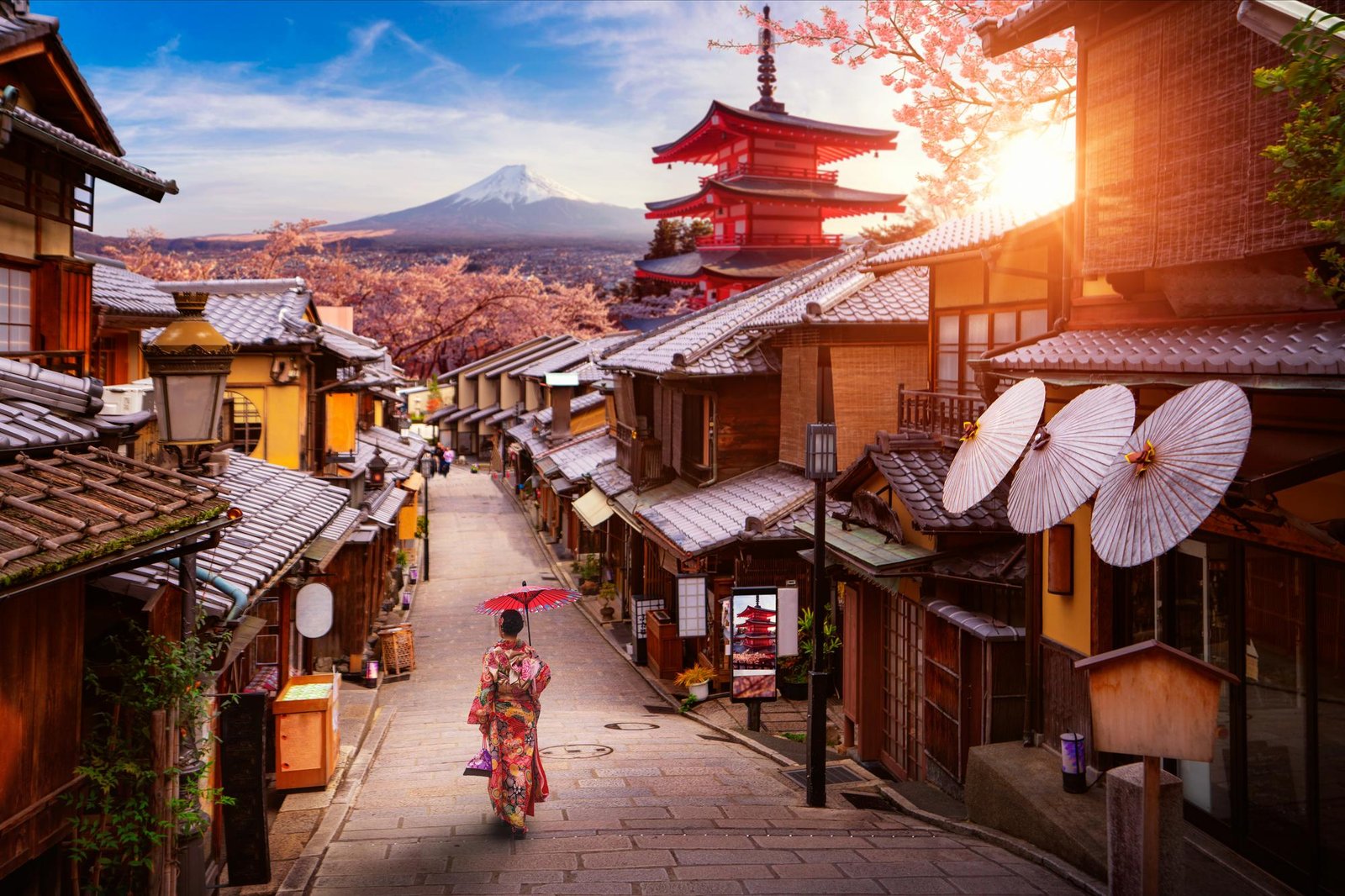
Japan Uncovered: Where to Go, When to Visit & What to Know
Tokyo, Kyoto, Osaka and Mount Fuji, the best time to visit, itinerary ideas and transportation tips — everything you need to plan a Japan trip that fits the way you actually want to travel.
There is a particular kind of panic that occurs when you encounter your first Japanese toilet.
There are buttons.
Many buttons.
Some control water. Some control temperature. One may play music. Somewhere in the middle of all this technology is a traveller staring at a panel of unfamiliar symbols and hoping they have not accidentally launched a sequence they cannot reverse.
Japan is full of moments like this.
You step out of one of the busiest railway stations on earth and, ten minutes later, find yourself eating dinner at a six-seat counter down a quiet alley. You ride a bullet train at extraordinary speed, then spend the night sleeping on tatami in an inn where dinner follows traditions refined over generations.
Ancient shrines sit beside glass towers. Vending machines appear in places where no vending machine seems strictly necessary. Convenience stores can produce a surprisingly respectable lunch. Trains are so efficient that visitors begin judging transportation systems back home rather unfairly by about day four.
Japan feels futuristic and deeply traditional at the same time.
The useful surprise is that, once the itinerary is designed properly, it can also be remarkably easy to explore.
So where should you begin?
Tokyo or Kyoto? How many days do you need in Japan? When is cherry blossom season? Should you add Osaka, Hiroshima or Mount Fuji? Is the Japan Rail Pass worth it?
This Japan travel guide covers the essentials for planning a first — or next — journey through one of Asia's most fascinating countries.
Where Should You Go in Japan?
Japan offers far more variety than many first-time travellers expect.
There are enormous cities, temple towns, volcanic landscapes, tropical islands, ski resorts, mountain villages and regions where dinner alone can justify the journey.
For most first visits, Tokyo, Kyoto and Osaka form the natural foundation.
They also happen to be completely different from one another, which is exactly why the combination works.
Tokyo shows you modern Japan at full speed.
Kyoto slows everything down.
Osaka makes sure nobody becomes too serious about either.
Beyond those three, destinations such as Mount Fuji and Hakone, Hiroshima and Miyajima, Hokkaido and Okinawa reveal entirely different versions of the country.
Tokyo
Shibuya, Shinjuku, Ginza, Asakusa, Harajuku & Omotesando
Tokyo Is Not One City. That Helps.
Tokyo is enormous.
This is obvious on a map and somehow still surprising when you arrive.
Trying to "see Tokyo" as though it has one compact centre is the first mistake. It is better understood as a collection of neighbourhoods, each with its own personality, connected by one of the world's most extensive transportation systems.
This also means the city changes dramatically within a few train stops.
Shibuya: Neon, Fashion and Controlled Chaos
Shibuya delivers the Tokyo many visitors imagine before arrival.
Giant screens. Fashion. Restaurants. Nightlife. Crowds.
And, of course, the famous Shibuya Crossing, where hundreds of people move through the intersection at once and somehow manage it with considerably more order than many smaller crossings elsewhere in the world.
Come for the spectacle.
Stay for the neighbourhood around it.
Shinjuku: Skyscrapers Above, Tiny Alleys Below
Shinjuku contains some of Tokyo's most striking contrasts.
On one side: major towers, department stores and transportation infrastructure on a heroic scale.
On another: narrow streets, tiny restaurants and atmospheric entertainment districts.
It can feel overwhelming initially.
That usually passes just before you become completely fascinated by it.
Ginza: Tokyo Polishes Its Shoes
Ginza is the Tokyo of sophisticated department stores, luxury boutiques, galleries, refined restaurants and beautifully designed hotels.
Everything feels slightly more composed here.
Even the buildings appear to have excellent posture.
It is particularly appealing for travellers who value upscale shopping, fine dining and a central location.
Asakusa: Tokyo Before the Glass Towers
Around Senso-ji, Asakusa offers a glimpse of an older Tokyo.
Traditional streets, temple architecture and small shops provide a sharp contrast to the city's more futuristic districts.
Visit early and the atmosphere changes considerably.
Before the busiest hours arrive, there is space to notice incense drifting through the temple grounds and shopkeepers beginning the day.
Tokyo becomes easier to understand when you see both this and Shibuya.
Harajuku & Omotesando: Youth Culture Meets Serious Design
Harajuku has long been associated with youth fashion and contemporary culture.
Nearby Omotesando brings a more polished side of fashion, architecture and design.
Together they show one of Tokyo's defining characteristics:
The city can be playful and extremely serious about aesthetics at the same time.
How Long Should You Stay in Tokyo?
For a first visit, three to five nights works well.
That gives you enough time to explore several neighbourhoods without treating the railway network like a competitive sport.
Tokyo can also work as a base for day trips, allowing you to explore nearby areas without constantly checking in and out of hotels.
And do not worry if you leave feeling that you have not "finished" Tokyo.
Nobody has.
Kyoto
Fushimi Inari, Kiyomizu-dera, Kinkaku-ji, Arashiyama & Gion
Kyoto Is the Japan Many Travellers Have Been Imagining for Years
If Tokyo represents Japan's extraordinary present, Kyoto brings you closer to its cultural past.
Temples. Shrines. Gardens. Wooden houses. Traditional neighbourhoods.
At first glance, Kyoto appears serene.
Then you arrive at one of its most famous temples at 11 a.m. and discover that approximately everyone else in Japan appears to have had the same idea.
Timing matters here more than almost anywhere else.
Fushimi Inari: Go Before Breakfast
The seemingly endless torii gates of Fushimi Inari are among Kyoto's most recognizable images.
The route becomes quieter the farther you climb.
It also becomes steeper.
This is an important detail rarely communicated by perfectly composed photographs.
Arrive early.
The lower sections become busy later in the morning, while an early visit gives you a better chance to experience the atmosphere that makes the shrine compelling in the first place.
Your calves may have separate opinions.
Kiyomizu-dera: Kyoto From Above
Kiyomizu-dera occupies a hillside position overlooking the city.
The temple is impressive in any season, but spring and autumn can make the surrounding landscape particularly striking.
The journey through the streets leading to the temple is part of the experience.
So is occasionally moving aside for someone conducting what appears to be a professional photoshoot with no professional photographer present.
Kinkaku-ji: Yes, It Really Is That Gold
The Golden Pavilion is one of those landmarks that looks almost suspiciously perfect in photographs.
Then you arrive.
It is still gold.
Its reflection across the pond is especially striking on a calm day.
The visit itself can be relatively short, but it pairs well with other Kyoto experiences rather than becoming an entire day's plan.
Arashiyama: More Than Bamboo
The bamboo grove gets most of the photographs.
Arashiyama deserves more time than the bamboo walkway alone.
Temples, river scenery and surrounding neighbourhoods make the district a broader experience, particularly if you arrive early and continue beyond the most photographed section.
The bamboo is beautiful.
So is not sharing every square metre of it with several hundred phones.
Gion: Slow Down
Gion is one of Kyoto's best-known traditional districts.
Walk rather than rush.
Look at the wooden architecture. Notice the smaller side streets. Stop for tea.
And remember that this is a living neighbourhood, not a film set.
Kyoto becomes much more rewarding when you stop treating it as a collection of temples and allow the city itself to become part of the trip.
How Long Should You Stay in Kyoto?
Plan approximately three or four nights for a first visit.
That gives you time to explore at a more civilized pace and makes room for a day trip to Nara, known for historic temples, shrines and its famously confident deer.
The deer are accustomed to visitors.
They are also aware that you may be carrying snacks.
Negotiate accordingly.
Osaka
Dotonbori, Food, Nightlife & the Kansai Region
Osaka Takes Food Personally
Osaka feels noticeably different from both Tokyo and Kyoto.
It is more informal.
More exuberant.
And possibly more interested in what you are having for dinner.
The illuminated streets around Dotonbori provide the city's most familiar image: neon signs, restaurants and crowds moving along the canal after dark.
But Osaka's real personality emerges through its food culture.
This is a city where casual dishes matter.
Where eating well does not require a hushed dining room.
Where you can have an excellent meal while sitting a few feet from the person cooking it.
If food is important to your trip, Osaka deserves more than an afternoon.
Osaka as a Base
Osaka also works extremely well as a base for exploring the wider Kansai region.
From here, travellers can combine:
- Kyoto
- Nara
- Kobe
- Other nearby destinations
For many itineraries, two or three nights works well.
Longer if dinner keeps interfering with departure plans.
Mount Fuji & Hakone
Hakone, Fuji Five Lakes & Lake Kawaguchi
Mount Fuji Has No Obligation to Appear
Mount Fuji is one of Japan's defining images.
It is also perfectly capable of hiding behind clouds for the entire day.
You can travel closer.
You can book a room facing the mountain.
You can wake early.
Fuji does not care.
Weather matters enormously, and no itinerary can guarantee a clear view.
That unpredictability is part of the experience.
Hakone
Hakone is a popular addition to a Tokyo itinerary because it combines mountain scenery, hot springs and traditional accommodation.
It works particularly well for travellers who want a slower pause between major cities.
Fuji Five Lakes
The Fuji Five Lakes region, including Lake Kawaguchi, offers another way to experience the mountain.
When conditions cooperate, lake views toward Fuji can be exceptional.
When they do not, the region still offers scenery and a quieter pace than Tokyo.
Stay in a Ryokan
A night in a traditional ryokan, particularly one with an onsen, can become one of the most memorable parts of a Japan itinerary.
Arrive. Change into a yukata. Have dinner. Use the bath.
Realize that your evening has somehow become far more peaceful than anything you normally do at home.
That is the point.
Hiroshima & Miyajima
Peace Memorial Park & Itsukushima Shrine
Hiroshima: A Place That Requires Time and Attention
Travellers with additional time should consider continuing west to Hiroshima.
The Hiroshima Peace Memorial Park and museum offer an important opportunity to understand one of the defining events of the twentieth century.
This is not a place that benefits from rushing.
Give it the time and seriousness it deserves.
Miyajima: A Different Mood Entirely
Nearby Miyajima provides a powerful contrast.
The island is known for Itsukushima Shrine and its famous torii gate, which appears to stand in the water at high tide.
The atmosphere is calmer, scenic and markedly different from Hiroshima city.
The pairing works exceptionally well because the experiences are so different.
For many itineraries, one or two nights is enough to incorporate Hiroshima and Miyajima beyond the classic Tokyo–Kyoto–Osaka route.
Hokkaido
Japan Changes Completely in the North
Hokkaido is Japan for travellers who thought they understood the country after visiting Tokyo and Kyoto.
Then winter arrives.
Snow transforms the landscape. Ski resorts become the focus. Food culture changes. The scale feels broader and more rural.
During winter, Hokkaido becomes one of Asia's major destinations for skiing and snowboarding.
In warmer months, the experience shifts toward:
- National parks
- Hiking
- Flower fields
- Scenic road trips
- Cooler temperatures than many parts of central and southern Japan
Hokkaido is especially appealing for repeat visitors looking beyond the classic first-time route.
It is still Japan.
Just wearing considerably more outerwear.
Okinawa
Japan, Except Tropical
Not every journey through Japan needs to revolve around temples, bullet trains and urban neighbourhoods.
Travel far south and the landscape changes dramatically.
Okinawa offers subtropical islands, beaches, marine life and a cultural identity distinct from mainland Japan.
It can work as a relaxing extension after a city-heavy journey or as an entirely separate trip for travellers interested in:
- Diving
- Beaches
- Island exploration
- Marine experiences
The contrast can be startling.
One week you are standing beneath neon in Tokyo.
The next you are in tropical water.
Japan contains multitudes.
When Is the Best Time to Visit Japan?
There is no single perfect month.
Japan changes dramatically through the seasons, and the "best" time depends on what you came to experience.
Spring: March to May
Spring is Japan's most famous travel season.
Cherry blossoms typically appear across many popular destinations from late March into April, although exact timing changes each year and varies considerably by region.
It is beautiful.
It is also busy.
Very busy.
A country famous for orderly queues receives an excellent opportunity to demonstrate them.
Flights, hotels and sought-after experiences can become more expensive and harder to secure during peak blossom season.
If sakura matters to you, plan early.
But remember:
Nature has not signed your itinerary.
Bloom dates shift.
Weather changes.
Travel for Japan first.
Perfect blossoms should be treated as a spectacular bonus.
Watch for Golden Week
Golden Week, generally occurring from late April into early May, is one of Japan's busiest domestic travel periods.
Transportation and accommodation can become particularly crowded.
If your dates are flexible, visiting just before or after can make the journey considerably easier.
Summer: June to August
Japanese summers can be hot and humid, particularly in major cities.
There is "warm."
There is "summer."
And then there is the moment you step out of a Tokyo station in August and realize your shirt has entered a different phase of existence.
Summer does, however, bring another side of Japan to life.
Festivals, fireworks and seasonal celebrations take place across the country, particularly during July and August.
Travellers looking for cooler conditions can consider:
- Hokkaido
- Mountain regions
- Higher-elevation destinations
Obon in August is another major domestic travel period, when transport and hotels can become busier.
Autumn: September to November
Autumn is one of the strongest alternatives to cherry blossom season.
Temperatures become more comfortable, while changing leaves transform temples, gardens and mountain landscapes.
October and November can be particularly attractive for a classic Tokyo–Kyoto–Osaka itinerary.
Kyoto in autumn is especially photogenic.
This is not classified information.
Expect company.
Early autumn can also bring more unsettled weather in some parts of Japan, so flexibility helps.
Winter: December to February
Japan in winter deserves far more attention than it receives.
Tokyo and Osaka generally offer a completely different winter experience from the heavy snowfall found in northern Japan and mountainous regions.
Winter is ideal for:
- Skiing and snowboarding
- Hokkaido
- Nagano
- Hot springs
- Snow-covered villages
- Seasonal cuisine
- Travellers who prefer fewer crowds in major cities
It is also one of the best seasons for combining a ryokan stay with an onsen.
There are few more convincing arguments for winter than sitting in hot water while snow falls around you.
How Many Days Do You Need in Japan?
Japan encourages ambitious planning because the trains are so good.
Do not fall for it.
Just because you can reach another city today does not mean your suitcase needs the exercise.
7 Days
Keep it simple.
Consider: Tokyo + Kyoto, or Tokyo + Mount Fuji/Hakone
Another sensible option is to base yourself primarily in one major city and add day trips rather than repeatedly changing hotels.
Seven days is enough for a good Japan trip.
It is not enough for every Japan trip.
10 Days
A strong first-time itinerary could look like:
Tokyo → Hakone/Mount Fuji → Kyoto → Osaka
This gives you:
- Modern Japan
- Traditional culture
- Mountain scenery
- A ryokan opportunity
- Food-focused Osaka
without turning the trip into an extended luggage-management programme.
12–14 Days
For many first-time visitors, two weeks is an ideal amount of time.
Consider:
Tokyo → Hakone → Kyoto → Nara → Osaka → Hiroshima/Miyajima
This introduces several sides of Japan while leaving enough time to experience them properly.
More Than Two Weeks
This is where Japan becomes particularly interesting.
Consider adding:
- Kanazawa
- Takayama
- Koyasan
- Hiroshima
- Kyushu
- Hokkaido
- Okinawa
- The Japanese Alps
- Smaller towns
- Countryside stays
Do not simply add more major cities.
Use the extra time to change the rhythm of the journey.
The memorable part of a longer trip is often the place you had barely heard of before planning it.
Getting Around Japan
Transportation in Japan is not merely functional.
For many visitors, it becomes part of the attraction.
There is something deeply satisfying about a railway system that makes you briefly believe human civilization may, in fact, be capable of organization.
Shinkansen: The Bullet Train
Japan's Shinkansen trains make it practical to combine major destinations such as Tokyo, Kyoto and Osaka.
For first-time visitors, they can dramatically simplify a multi-city itinerary.
Rather than flying between every city, you can often move efficiently from one centre to another.
The trains are fast.
The boarding process is orderly.
And there will come a point when you look at the clock, realize exactly how punctual everything is, and think uncomfortable thoughts about transportation back home.
Do You Need a Japan Rail Pass?
Not necessarily.
The Japan Rail Pass can make financial sense for some itineraries, but it should not automatically be purchased simply because you are visiting Japan.
Its value depends on:
- The cities you are visiting
- The number of long-distance journeys
- The timing of those trips
- Which trains and routes you intend to use
The correct sequence is:
Build the itinerary first.
Then compare the cost of individual tickets with relevant passes.
Buying transportation first and designing the trip around it is rather like buying shoes and then deciding where you should walk.
Use an IC Card for Local Transportation
Rechargeable IC cards can make local trains, subways and many everyday purchases considerably easier.
Japan's urban transportation systems may initially look intimidating.
Tokyo station maps can occasionally resemble electrical schematics.
But signage in major tourist areas generally makes navigation manageable for international visitors.
The biggest adjustment is often not understanding the trains.
It is understanding the stations.
Some are enormous.
Allow extra time.
When Google Maps says you have arrived, this may merely mean you have entered the railway ecosystem.
Your platform could still be several escalators and one existential crisis away.
Where Should You Stay in Japan?
Hotel location matters enormously.
A beautiful hotel in the wrong area can cost you time every single day.
Choose location according to how you actually want to experience the city.
Where to Stay in Tokyo
Shinjuku or Shibuya — best for:
- Energy
- Restaurants
- Nightlife
- Convenient transportation
Ideal if you want Tokyo outside your door.
Ginza — best for:
- Luxury shopping
- Sophisticated hotels
- Refined dining
- A polished central atmosphere
Asakusa — best for:
- A more traditional feel
- Temple atmosphere
- Travellers who prefer a quieter side of Tokyo
Tokyo Station / Marunouchi — particularly convenient when rail connections matter.
This can save valuable time if your itinerary includes multiple Shinkansen journeys.
Where to Stay in Kyoto
Consider:
- Gion
- Central Kyoto
- Areas near convenient transportation hubs
The right location can significantly reduce time spent crossing the city between sights.
Stay in a Ryokan at Least Once
A traditional ryokan should not be treated as simply another hotel night.
It can involve:
- Tatami rooms
- Japanese-style hospitality
- Seasonal meals
- Futon bedding
- Onsen bathing at many properties
The rhythm is different from an international hotel.
Lean into it.
If somebody has carefully prepared a multi-course seasonal dinner and your futon while you were bathing, this is probably not the evening to ask where the nearest sports bar is.
What Should You Eat in Japan?
Japanese food goes considerably beyond sushi.
One of the pleasures of travelling through the country is discovering how much the cuisine changes by region.
Look for:
- Sushi and sashimi
- Ramen
- Tempura
- Yakitori
- Tonkatsu
- Okonomiyaki
- Udon
- Soba
- Wagyu
- Kaiseki
- Regional specialties
Osaka: Eat Casually and Often
Osaka is particularly associated with informal food culture.
Come hungry.
This is useful advice throughout Japan, but especially here.
Kyoto: Food as Season
Kyoto is one of the best places to explore more traditional cuisine, including kaiseki.
A kaiseki meal may unfold through a series of small courses shaped by season, ingredients, presentation and occasion.
Even the dishware may change according to the time of year.
A leaf can be part of the presentation.
A blossom can signal spring.
Dinner begins behaving slightly like a calendar.
Tiny Restaurants Can Be Extraordinary
Some of Japan's most memorable meals are served in restaurants with only a handful of seats.
Do not judge by size.
A room containing eight chairs may still be one of the most serious restaurants you visit all year.
Japan has perfected the ability to hide extraordinary food behind doors that make first-time visitors wonder whether they are actually allowed inside.
Japan Entry Requirements
Entry and visa requirements depend on your nationality, passport and the length and purpose of your stay.
Many travellers can visit Japan for short tourism stays without obtaining a visa in advance, while others may require one.
Before travelling, verify:
- Whether your passport qualifies for visa-free entry
- How long you are permitted to stay
- Passport validity requirements
- Arrival and customs procedures
- Whether onward or return travel documentation is required
Requirements can change, so always confirm the official Japanese government rules applicable to your passport before departure.
Important Things to Know Before Visiting Japan
Do Not Try to See Everything
Japan rewards slower travel.
Changing hotels every night simply because the train network technically allows it is not a challenge you need to accept.
Public Transportation Is Quiet
Behaviour considered perfectly ordinary elsewhere may stand out on Japanese public transportation.
Follow the room.
If everyone else is quiet, this is probably not the moment to conduct a speakerphone conversation across three time zones.
Carry Some Cash
Electronic payment is increasingly common, but Japanese yen remains useful for:
- Smaller businesses
- Temples
- Markets
- Traditional establishments
Japan can feel extraordinarily technologically advanced until you encounter a place that prefers cash.
Then, somehow, both things remain true.
Tattoos Can Matter at Onsen
Travellers with tattoos should check policies before visiting an onsen, pool or similar facility.
Some properties may ask guests to cover tattoos, while others may restrict entry.
Private onsen options can be an excellent alternative.
Check before arriving in a towel.
Pack Lighter Than You Think
Oversized luggage and enormous railway stations are not natural allies.
Japan is an excellent destination for travelling efficiently.
Luggage-forwarding services can also be extremely useful when moving between several cities.
Your suitcase does not need to experience every Shinkansen personally.
Common First-Time Japan Mistakes
Spending Too Little Time in Kyoto
Kyoto is not best experienced by racing through eight temples in one day.
Three carefully chosen places and a quiet neighbourhood walk can create a better memory than a checklist containing twice as much.
Making Every Day Too Busy
Japan is stimulating enough without scheduling every waking minute.
Leave space.
You will use it.
Assuming Cherry Blossoms Are Guaranteed
They are not.
Bloom dates shift annually and vary by region.
Plan for Japan.
Hope for sakura.
This arrangement produces far less disappointment.
Only Visiting Tokyo
Tokyo alone could easily fill an entire holiday.
But Japan's contrasts become much clearer when you combine it with Kyoto, mountains, countryside or smaller cities.
A Tokyo-only trip shows you Tokyo magnificently.
It does not show you Japan completely.
Buying Rail Passes Before Building the Itinerary
Route first.
Tickets second.
The transportation should support the holiday.
The holiday should not become an elaborate attempt to justify the transportation pass you already bought.
What Kind of Japan Trip Is Right for You?
For First-Time Visitors
Consider: Tokyo → Kyoto → Osaka
Add Mount Fuji or Hakone if time allows.
It is popular because it works.
For Couples
Consider: Tokyo → Hakone ryokan → Kyoto
The contrast is excellent:
Big city. Mountain retreat. Traditional culture.
Add a luxury countryside or onsen stay if you want the pace to slow further.
For Food Lovers
Build around: Tokyo → Kyoto → Osaka
Then add regional culinary experiences rather than spending the entire trip chasing famous restaurant names.
The best meal may not be the one you bookmarked six months earlier.
For Families
Tokyo and Osaka offer an enormous range of attractions, while Kyoto introduces history and culture.
Limit hotel changes.
Build in free time.
And accept that the convenience store may become unexpectedly important.
Japanese convenience stores have rescued many a travelling family from the complex international crisis known as:
"Nobody agrees what they want for lunch."
For Nature & Adventure
Consider:
- Hokkaido
- Japanese Alps
- Nagano
- Kyushu
- National park regions
For Skiing
Look north and into the mountains.
Hokkaido and Nagano are among Japan's best-known winter destinations.
How to Plan a Better Japan Itinerary
Start by deciding what kind of contrast you want.
City and countryside?
Tokyo intensity and Kyoto tradition?
Temples followed by beaches?
Bullet trains followed by hot springs?
Then build the route geographically.
Do not add a destination merely because it is famous.
Give major cities enough nights to breathe.
Use a ryokan or countryside stay to change the pace.
Avoid changing hotels unnecessarily.
Leave one afternoon with very little planned.
Japan is unusually rewarding when you give yourself time to notice the smaller things.
The bakery hidden inside a station.
The tiny shrine behind an office block.
The restaurant with six seats.
The convenience store dessert that has no business being that good.
The vending machine standing alone beside a country road, apparently confident somebody will eventually become thirsty.
And yes, the bathroom where the toilet seat is heated and you begin quietly questioning why every other country has accepted cold toilet seats for this long.
The Talaria View
Japan can seem complicated from Canada.
Different cities. An enormous rail network. Thousands of hotels. Seasonal travel patterns. Restaurant reservations. Rail passes. Temple etiquette. Onsen rules. And a toilet control panel that briefly appears to require technical certification.
Then you arrive.
The system begins making sense.
The trains connect.
The cities reveal their personalities.
And the contrasts that seemed difficult to combine on paper become the reason the journey works.
Tokyo's neon and Kyoto's quiet.
A Shinkansen and a centuries-old inn.
A six-seat restaurant in a city of millions.
A mountain onsen after several days of urban intensity.
That is Japan at its best.
Not one experience repeated across several cities.
A series of completely different moments connected by a country remarkably good at making contradictions feel natural.
At Talaria Voyages, we create Japan journeys around the individual traveller — from international flights and carefully selected hotels to private experiences, rail planning, guided touring and complete multi-city itineraries.
Because Japan does not need a longer checklist. It needs the right rhythm.
Travel requirements, hotel offerings, airline schedules and government advisories can change. Destination and entry information should always be reconfirmed for your specific travel dates before departure.
Ready to plan a Japan trip that actually fits your pace? Let's design the right itinerary for you.
Or reach us directly on WhatsApp — we respond fast and love talking Japan itineraries.
Talaria Voyages is a Canadian-based luxury travel atelier, IATA TIDS registered (Code: 96235812), serving travellers worldwide.