
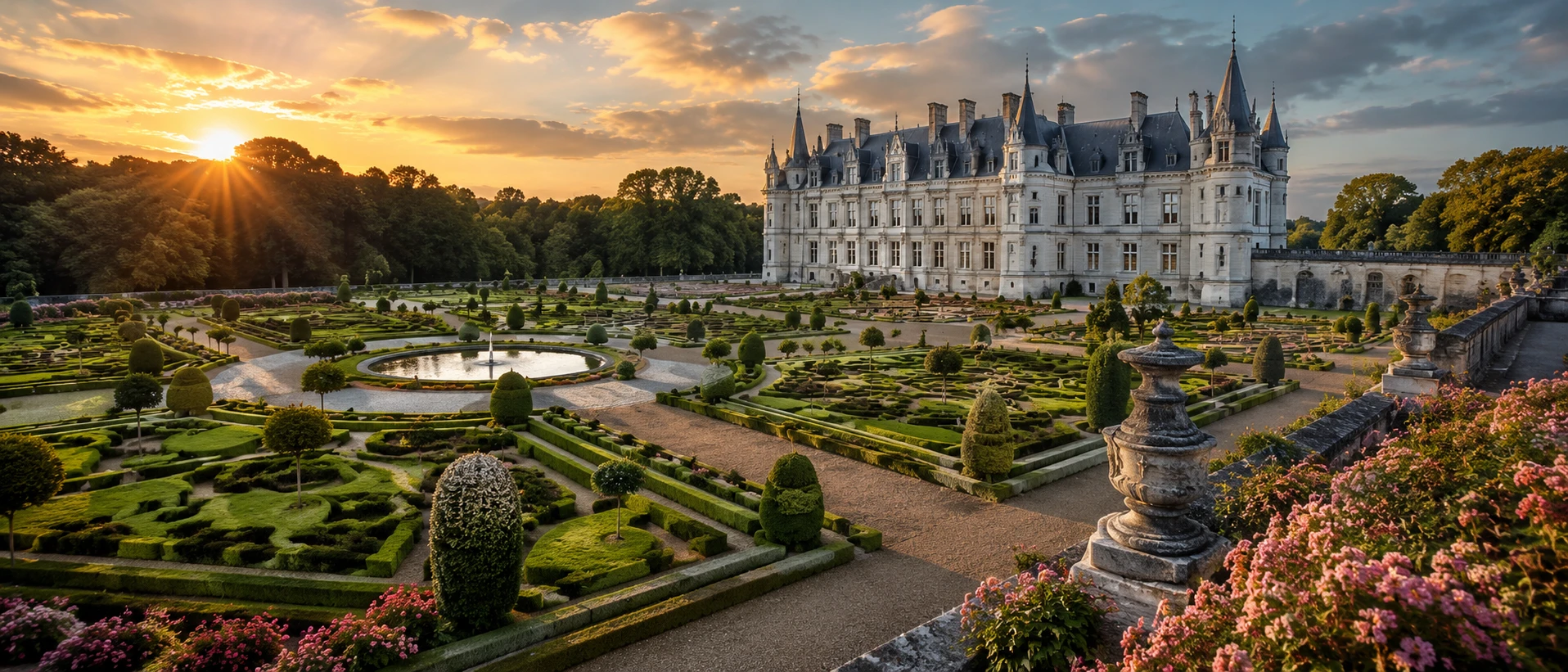
France Beyond the Eiffel Tower: Castles, Gardens & the Stories Worth Travelling For
Loire Valley castles, royal gardens, Provence, Normandy, Burgundy and the human stories behind them — the France that begins where the Eiffel Tower ends.
France has around 45,000 châteaux.
Which raises a reasonable question: at what point did the French decide that a normal-sized house simply wasn't impressive enough?
Some were fortresses designed to survive sieges. Others were royal residences, hunting lodges or country estates. A surprising number seem to have been built because somebody wealthy looked at another wealthy person's château and concluded that theirs required more towers.
And that is before we get to the gardens.
France may be represented internationally by one iron tower in Paris, but the country beyond the Eiffel Tower is considerably stranger, older and more varied.
There are Renaissance palaces where royal mistresses competed through landscaping. A château whose owner's spectacular dinner party for Louis XIV was followed three weeks later by his arrest. A garden Monet deliberately created so he would have something interesting to paint. Villages perched above vineyards. Medieval towns. Roman ruins. Atlantic cliffs. Alpine valleys. Restaurants where lunch can consume an afternoon without anybody considering this a scheduling problem.
Paris deserves its reputation.
But Paris is the front door.
Here is what happens when you keep going.
Start With Paris — Just Don't End There
There is no need to become contrarian about the Eiffel Tower.
Go.
Walk beneath it. See it from the Seine. Watch it illuminate after dark. Paris has earned its place in a first France itinerary.
Then allow the city to become more than its monuments.
Walk through neighbourhoods early in the morning when bakeries are opening and café terraces are being assembled. Spend an afternoon in the Marais. Cross into Saint-Germain. Sit down for lunch without treating the waiter as an obstacle between you and the next attraction.
France begins making considerably more sense once you notice that meals, gardens and public spaces are not simply pauses between sightseeing.
They are part of the day.
And once Paris has introduced the idea, the rest of the country takes it much further.
The Loire Valley: Where Architecture Became a Competitive Sport
If France's château obsession requires an explanation, the Loire Valley is a good place to look for one.
Kings, queens, ministers and ambitious members of the court built or transformed residences here for generations. Today, celebrated estates including Chambord, Chenonceau, Amboise, Azay-le-Rideau and Villandry form one of France's great concentrations of historic architecture and gardens.
Do not attempt to visit every château.
Château fatigue is real.
After several days, even an exceptionally beautiful sixteenth-century staircase can begin receiving the response normally reserved for hotel corridors.
Choose the places with the best stories.
Château de Chambord: Francis I's Modest Little Hunting Lodge
"Hunting lodge" is doing heroic work when applied to Château de Chambord.
Its roofline contains 282 chimneys, along with turrets and towers that make the top of the building resemble a miniature stone city. At the centre is Chambord's famous double-helix staircase: two intertwined ramps allow people to ascend and descend while potentially never meeting. The château describes the design as inspired by Leonardo da Vinci.
This is exactly the sort of architectural solution one expects from a royal residence.
A normal staircase would presumably have lacked drama.
King Francis I initiated Chambord in the early sixteenth century, and the result is less a comfortable country house than a declaration of Renaissance ambition rendered in stone. The double staircase remains the star, but climb all the way to the terraces: the forest and elaborate roofscape make the building easier to understand from above.
Why go: for monumental architecture, royal ambition and one of the great rooflines of France.
Talaria tip: Give Chambord enough time to reach the terraces. Photographing the façade and leaving misses much of what makes it peculiar.
Château de Chenonceau: When a Royal Love Triangle Acquires Gardens
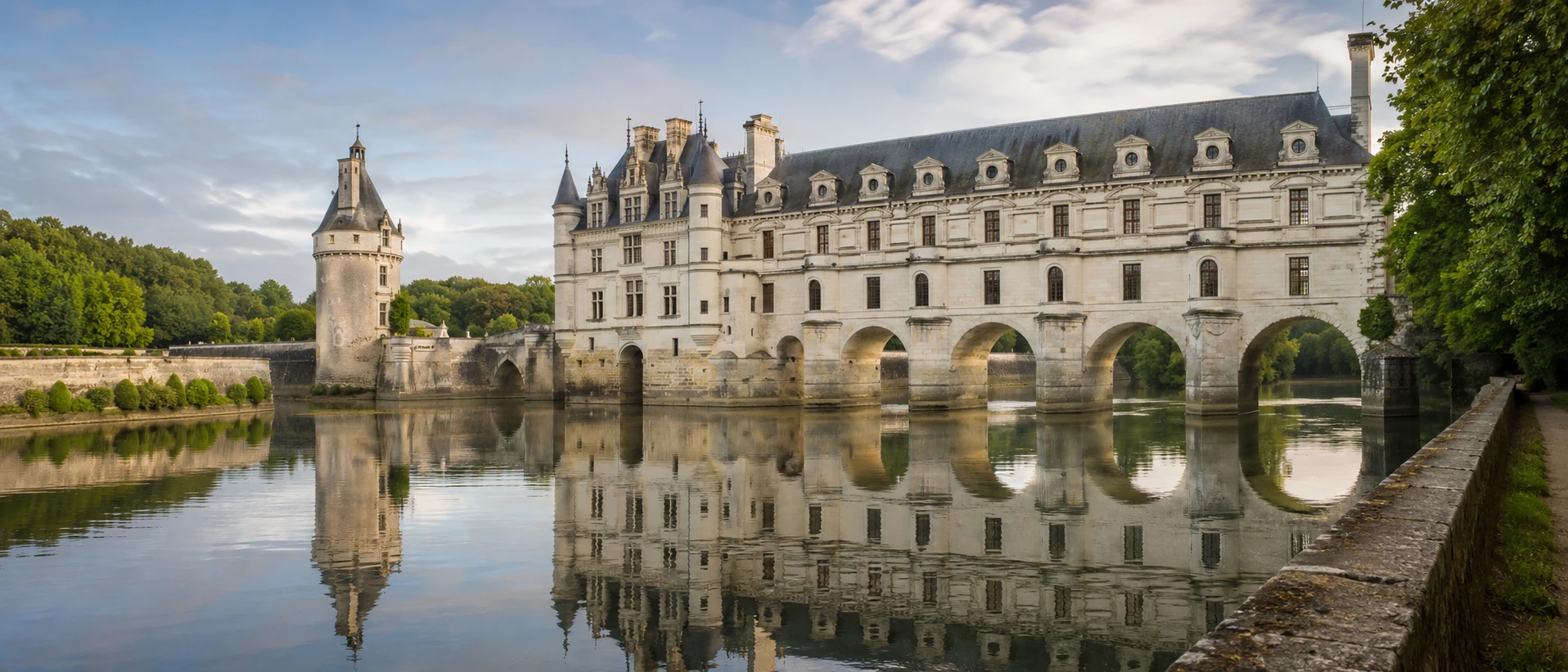
Chenonceau stretches across the River Cher so elegantly that it is easy to forget the amount of personal drama contained inside it.
King Henri II gave the château to his favourite, Diane de Poitiers, in 1547. Diane developed the estate and created her garden beside the château. Then Henri died in 1559.
His widow, Catherine de' Medici, moved quickly.
Catherine removed Diane from Chenonceau, took control of the château, continued its architecture and created gardens of her own.
Today the gardens of Diane de Poitiers and Catherine de' Medici still sit on opposite sides of the château.
Gardening has rarely been so passive-aggressive.
Chenonceau later became closely associated with a succession of influential women, earning its reputation as the Château des Dames — the Ladies' Château. Its unusual architecture crossing the Cher makes it one of the most distinctive buildings in the Loire Valley.
The pleasure is in seeing the entire composition: château, river and gardens together.
Why go: romance, rivalry, architecture and one of the most compelling human stories in the Loire.
Talaria tip: Do not visit only the interiors. The gardens are effectively part of the plot.
Villandry: The Vegetable Garden That Refuses to Look Practical
At Château de Villandry, even the cabbages have standards.
The château is known for elaborate formal gardens where vegetables and ornamental plants are arranged into geometric patterns. The Ornamental Kitchen Garden is one of the estate's centrepieces, transforming produce into something closer to landscape design.
The gardens also have an unexpectedly modern resurrection story.
By the nineteenth century, Villandry's earlier formal gardens had been replaced by a landscaped English-style park. In 1906, Spanish-born doctor Joachim Carvallo and his American wife Ann Coleman bought the estate. Carvallo disliked the English garden and spent the years from 1908 to 1918 reconstructing gardens intended to complement the château's Renaissance character.
It became the work of his life.
There is something wonderfully French about using extraordinary effort to ensure that lettuces are displayed with proper architectural discipline.
Why go: Villandry is one of the best garden visits in France, particularly for travellers who think they are "not really garden people."
This place has converted many.
Vaux-le-Vicomte: Possibly the Most Expensive Dinner Party in French History
On 17 August 1661, Nicolas Fouquet hosted Louis XIV at his château of Vaux-le-Vicomte.
He did not keep things low-key.
There was an elaborate feast. Illuminated gardens. Fireworks. Entertainment. Molière performed a new work. Fouquet had assembled architect Louis Le Vau, decorator Charles Le Brun and landscape designer André Le Nôtre to create an estate of extraordinary sophistication.
Louis XIV was not an ideal guest to impress too thoroughly.
Three weeks later, on 5 September 1661, Fouquet was arrested in Nantes by d'Artagnan, captain of the musketeers. After a lengthy trial, the king increased his sentence to life imprisonment. Fouquet eventually died in confinement in 1680.
His château survived.
So did his design team.
Louis XIV later employed the talents of Le Vau, Le Brun and Le Nôtre at Versailles, and Vaux-le-Vicomte became an important model for the royal estate.
There are several possible lessons here.
One is that seventeenth-century French politics was complicated.
Another is that if your boss is an absolute monarch, perhaps do not invite him to a house substantially nicer than his.
Why Vaux-le-Vicomte Deserves a Place on a France Itinerary
Versailles shows what royal power could build.
Vaux shows where some of the ideas came from — and gives them a much more intimate human story.
The château and gardens are also easier to comprehend as a single composition. Architecture, interiors, landscape and perspective were designed together.
You are not simply walking through a wealthy man's house.
You are walking through the scene of one of history's more unfortunate attempts to impress a dinner guest.
Versailles: Ignore the Temptation to Visit Only the Hall of Mirrors
Versailles is famous enough that many travellers approach it like an obligation.
Palace.
Hall of Mirrors.
Photograph.
Leave.
This is a mistake.
Louis XIV considered the gardens important enough that in 1661 he commissioned André Le Nôtre to develop them, and work continued for roughly four decades. Groves were designed as intimate outdoor rooms, filled with fountains, sculpture and theatrical surprises beyond the vast formal perspectives.
Versailles makes considerably more sense once you see the gardens not as landscaping around a palace, but as another expression of power.
Nature itself has apparently been informed that it should stand straight.
The Trianons: Even Louis XIV Needed to Escape Versailles
Perhaps the greatest irony at Versailles is that the man responsible for creating one of Europe's grandest royal courts eventually required somewhere to escape from it.
Louis XIV commissioned the retreat that evolved into the Grand Trianon partly to get away from court ceremony and to pursue his relationship with Madame de Montespan. The later marble palace was built in 1687, surrounded by gardens in which huge numbers of potted flowers could be changed to alter the display.
Imagine building Versailles.
Then deciding Versailles has become a little much.
That may be the most persuasive demonstration of royal excess in the entire estate.
Why go beyond the palace: The groves, fountains and Trianon estates make Versailles feel less like a museum and more like the world in which the court actually moved.
Giverny: Monet Did Not Simply Paint the Garden — He Built It
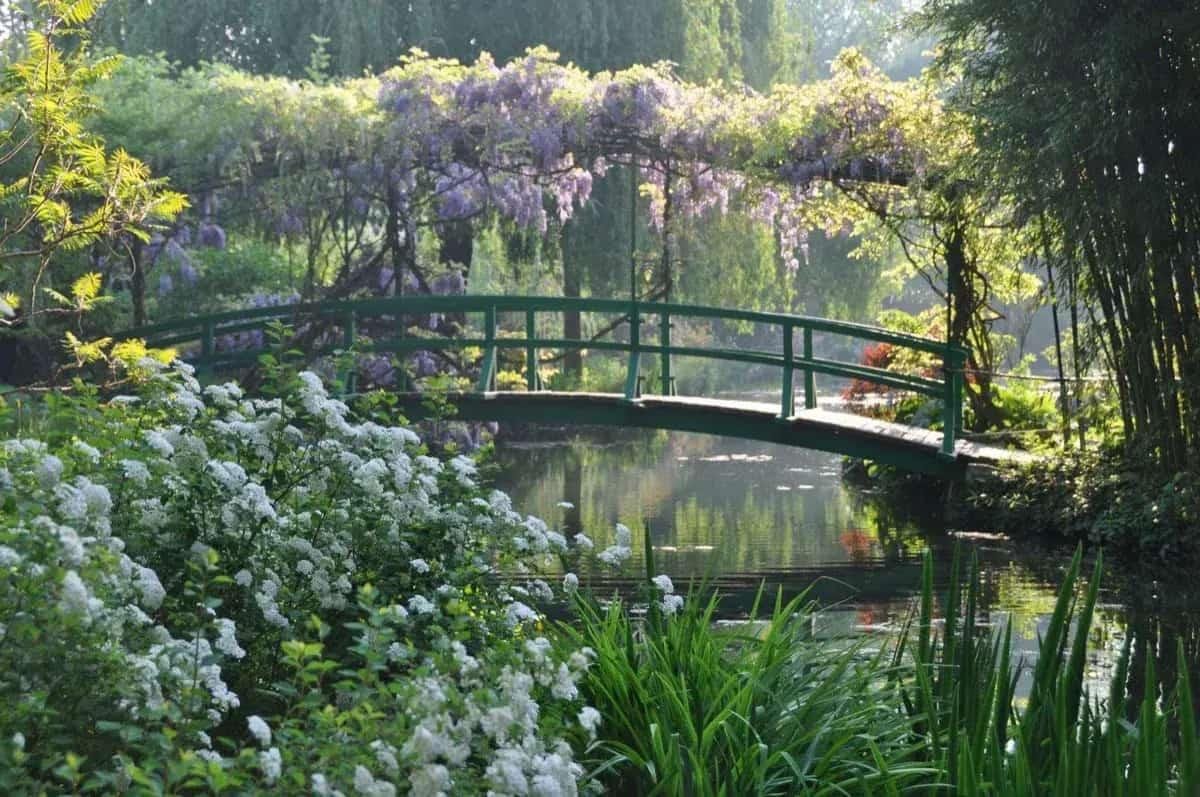
At Giverny in Normandy, Claude Monet did something unusual even by the standards of famous artists.
He created his own subject.
In 1893, Monet acquired land beside his property and developed the water garden that would eventually include the pond, Japanese bridge and water lilies familiar from his paintings. His local neighbours reportedly opposed aspects of the project because they feared his unfamiliar plants might contaminate the water.
Monet proceeded.
Artists can be stubborn.
Gardeners can be worse.
The water garden was influenced by the Japanese prints Monet collected, while the wisteria-covered bridge, willows and water lilies gradually became some of his most persistent subjects. He spent more than two decades drawing inspiration from the garden.
What makes Giverny extraordinary is the circular relationship between art and landscape.
Monet did not merely find a picturesque pond and paint it.
He shaped the pond.
Planted it.
Observed it.
Then painted the world he had created.
It may be one of art history's most elaborate forms of preparing your own reference material.
When Giverny Works Best
Go because you care about gardens as much as painting.
The experience is particularly satisfying when paired with seeing Monet's Water Lilies in Paris: one gives you the landscape he constructed, the other the extraordinary artistic world he extracted from it.
Dordogne: France Before the Formal Garden Learned to Behave
The Dordogne Valley feels different from the Loire.
The landscape is rougher.
Castles occupy cliffs and strategic heights. Villages cling to river bends. Forest, limestone and medieval architecture become part of the same view.
And then you encounter Marqueyssac.
Marqueyssac: 150,000 Boxwoods and Somebody With Excellent Patience
The Gardens of Marqueyssac contain more than 150,000 hand-pruned boxwoods along over six kilometres of paths overlooking the Dordogne Valley. The estate's belvedere rises about 130 metres above the river, providing views across a landscape filled with villages and castles.
The boxwood is not clipped into rigid geometric perfection.
Instead, great rolling shapes tumble beside the pathways like enormous green clouds.
It is formal gardening after somebody loosened the tie.
The garden works particularly well as part of a wider Dordogne stay around places such as Sarlat and the valley's historic villages rather than as an isolated day trip. Marqueyssac lies roughly eight kilometres south of Sarlat.
Why go: gardens, walking and one of the best elevated perspectives over the Dordogne.
Guédelon: The Medieval Castle That Isn't Finished Yet
Most château visits involve trying to imagine how people built these places centuries ago.
At Guédelon in Burgundy, you can simply watch them do it.
Around forty craftspeople are constructing a thirteenth-century-style fortified castle using medieval techniques and materials. Quarrymen, stonemasons, carpenters, blacksmiths, tile makers and other craftspeople work with stone, timber and earth from the surrounding site.
It is part construction project, part archaeological experiment and part answer to the question every child eventually asks inside a castle:
"But how did they actually build this?"
The cleverness of Guédelon is that history is not behind glass.
It is covered in dust and carrying a hammer.
For families, architecture enthusiasts and anyone who has seen enough fully furnished royal bedrooms for one vacation, it is one of France's most unusual heritage experiences.
France Beyond the Châteaux
The castles alone could fill several trips.
Do not let them.
France becomes most interesting when monumental places are mixed with ordinary landscapes, regional food and towns that operate according to their own rhythm.
Normandy: Art, Memory, Cliffs and Cheese
Normandy manages to contain Giverny, Mont-Saint-Michel, major Second World War memorial landscapes, Atlantic beaches, famous cliffs and towns associated with the Impressionists within the same broad region.
That variety makes it one of the strongest additions to Paris.
One day might revolve around Monet.
Another around medieval monastic architecture.
Another around twentieth-century history.
Then there is lunch.
Normandy has understood the useful culinary principle that cream, butter, apples and cheese rarely damage a situation.
Provence: The France Everyone Thinks They Remember
Provence has become so thoroughly romanticized that travellers sometimes arrive expecting every road to contain a lavender field, a stone farmhouse and a photogenic elderly gentleman carrying a baguette.
Reality is better.
Provence is a landscape of villages, markets, vineyards, Mediterranean vegetation, old cities and food traditions that vary from coast to interior. France's national tourism authority highlights the region across cultural heritage, nature and food-and-wine experiences rather than treating it simply as a lavender backdrop.
Build time for Aix-en-Provence, Avignon, smaller villages and countryside, rather than using the region as one prolonged photo stop.
And do not schedule every lunch tightly.
Provence is an excellent place to discover that a two-hour meal is not necessarily evidence of poor time management.
Alsace: France With a Different Accent
In northeastern France, Alsace shifts the architecture, food and landscape again.
Strasbourg leads naturally into the Alsace Wine Route and villages where half-timbered houses, vineyard landscapes and regional traditions reflect centuries of cultural exchange along the French-German borderlands.
It is particularly appealing for travellers returning to France who want somewhere that feels unmistakably French yet completely different from Paris or Provence.
Come in December and Christmas traditions become part of the attraction.
Come in warmer months and give more attention to the vineyards and villages.
Lyon & Burgundy: Come Hungry
France is one of those destinations where food should help determine geography.
Lyon makes an especially useful anchor for travellers interested in gastronomy, while Burgundy connects wine villages, historic towns and countryside into an itinerary where tasting becomes a perfectly legitimate form of sightseeing. France's tourism authority gives Lyon significant emphasis as both a cultural and food destination.
Do not build every meal around Michelin stars.
Markets, neighbourhood restaurants, bakeries and regional dishes often explain France more clearly than another grand monument.
The French have devoted centuries to arguing about butter, cheese, wine, sauces, bread and exactly how long lunch should take.
It would be impolite not to investigate.
What First-Time Visitors Get Wrong About France
They Treat Paris as France
Paris is magnificent.
It is also one city.
A Paris-only trip can be an excellent Paris trip, but it cannot explain vineyards in Burgundy, Mediterranean Provence, Normandy's coast, Loire châteaux or the villages of Alsace.
If you have ten days or more, give at least part of the journey to somewhere beyond the capital.
They Visit Too Many Châteaux in One Day
Three or four Loire castles on a rushed coach itinerary sounds efficient.
It can also produce an alarming inability to remember which king owned which staircase.
Two strong visits usually beat four hurried ones.
Pick the stories that interest you.
They Underestimate Gardens
In France, gardens are not decorative leftovers around the important building.
At Versailles, Chenonceau, Villandry, Vaux-le-Vicomte and Giverny, landscape design is part of the historical story itself.
Sometimes the garden tells you more about its owner than the bedroom furniture does.
They Rush Lunch
This is unnecessary.
France will still be there at 2:30.
They Assume Driving Is Always Necessary
France's major cities connect well by rail, while a car or private driver becomes much more valuable in rural areas where châteaux, vineyards, villages and countryside hotels are scattered beyond convenient station centres.
The sensible approach is often to combine both.
Train between major regions.
Drive where the landscape becomes part of the itinerary.
Best Time to Visit France
The best time to visit France depends on where you are going and what you want from the trip.
France extends from the Mediterranean to the English Channel and from Atlantic coastline to the Alps.
One weather forecast has little hope of representing all of that.
April to June: The Civilized Compromise
Spring into early summer works beautifully for many classic itineraries.
Gardens are coming into performance, daylight stretches later and sightseeing is generally more comfortable than at the height of summer.
This is particularly appealing for combinations involving Paris, Normandy, the Loire Valley, Provence and Burgundy.
If gardens are central to the trip, spring deserves serious attention.
July & August: Beautiful, Busy and Occasionally Very Hot
Summer makes sense for long evenings, Mediterranean travel and countryside stays.
It also brings peak demand to many famous destinations.
Book significant hotels and experiences well ahead if travelling during this period.
And remember that wandering through formal palace gardens under intense afternoon sun can change one's opinion of monarchy remarkably quickly.
September & October: France's Great Second Act
Early autumn is particularly persuasive.
Wine regions move toward harvest activity. The strongest summer crowds begin easing. Temperatures can become more comfortable for city and countryside touring.
This is an excellent period for itineraries built around Burgundy, Bordeaux, Provence, Paris and the Loire Valley.
October also gives gardens and forests a completely different palette.
November to March: Cities, Food and a Different France
Winter is not the season for every itinerary.
It is excellent for others.
Paris museums, Lyon's food scene, Strasbourg and Alsace during the Christmas period, and slower city-based trips can work beautifully when you are not relying on gardens or outdoor countryside experiences.
Some château and garden schedules are seasonal, so always check individual estates before travelling.
A Note for Canadian Travellers to France
Canadian citizens can currently visit France and other Schengen countries visa-free for up to 90 days within any 180-day period. A regular Canadian passport must be valid for at least three months beyond the date you expect to leave the Schengen Area.
The European Entry/Exit System (EES) is now operating and records short-stay travellers' entry and exit information; Canadians do not need to make a separate EES application before travelling.
As of August 2026, ETIAS is not yet operating. The European Union currently expects the travel-authorisation system to launch in the last quarter of 2026 and says no traveller action is required until it begins. Because this is changing information, Canadians should verify requirements again before departure.
How to Build a Better France Itinerary
Start with Paris if it is your first visit.
Then choose the France you actually want.
If castles and gardens are the priority, move into the Loire Valley.
If art and coastal history appeal, go toward Normandy.
If wine and food are dictating the schedule — an entirely respectable planning method — consider Burgundy, Lyon or Bordeaux.
If the trip needs countryside, markets and Mediterranean light, turn south toward Provence.
And leave space between the famous places.
The bakery you discover at 8 a.m.
The village market you did not know was happening.
The road through vineyards.
The garden bench occupied for twenty minutes longer than intended.
The waiter who seems completely unconcerned that you had planned to leave lunch an hour ago.
Those moments are not wasted itinerary.
They are usually the part travel brochures struggle to explain.
The Talaria View
Perhaps the Eiffel Tower's greatest achievement is convincing millions of travellers to come to France.
Its greatest disadvantage is making France appear easier to summarize than it is.
Because somewhere beyond Paris, two Renaissance women are still competing through their gardens at Chenonceau.
Chambord's 282 chimneys still crowd its roofline.
At Vaux-le-Vicomte, visitors wander through the estate where one extremely successful party contributed to an extraordinarily unsuccessful chapter in its owner's life.
Monet's water lilies still grow in the pond he created to paint.
And in Burgundy, people are still building a medieval castle by hand because apparently France's existing 45,000 châteaux were not quite enough.
Maybe that is the country worth travelling for.
Not simply the France of monuments everyone already recognizes.
The France of ambition, rivalry, art, gardens, food, landscapes and several centuries of people making things much more elaborate than strictly necessary.
The Eiffel Tower can be the beginning.
It should not be the entire story.
Travel requirements, hotel offerings, airline schedules and government advisories can change. Destination and entry information should always be reconfirmed for your specific travel dates before departure.
Ready to plan a France trip that goes beyond the Eiffel Tower? Let's design the right itinerary for you.
Or reach us directly on WhatsApp — we respond fast and love talking France itineraries.
Talaria Voyages is a Canadian-based luxury travel atelier, IATA TIDS registered (Code: 96235812), serving travellers worldwide.