
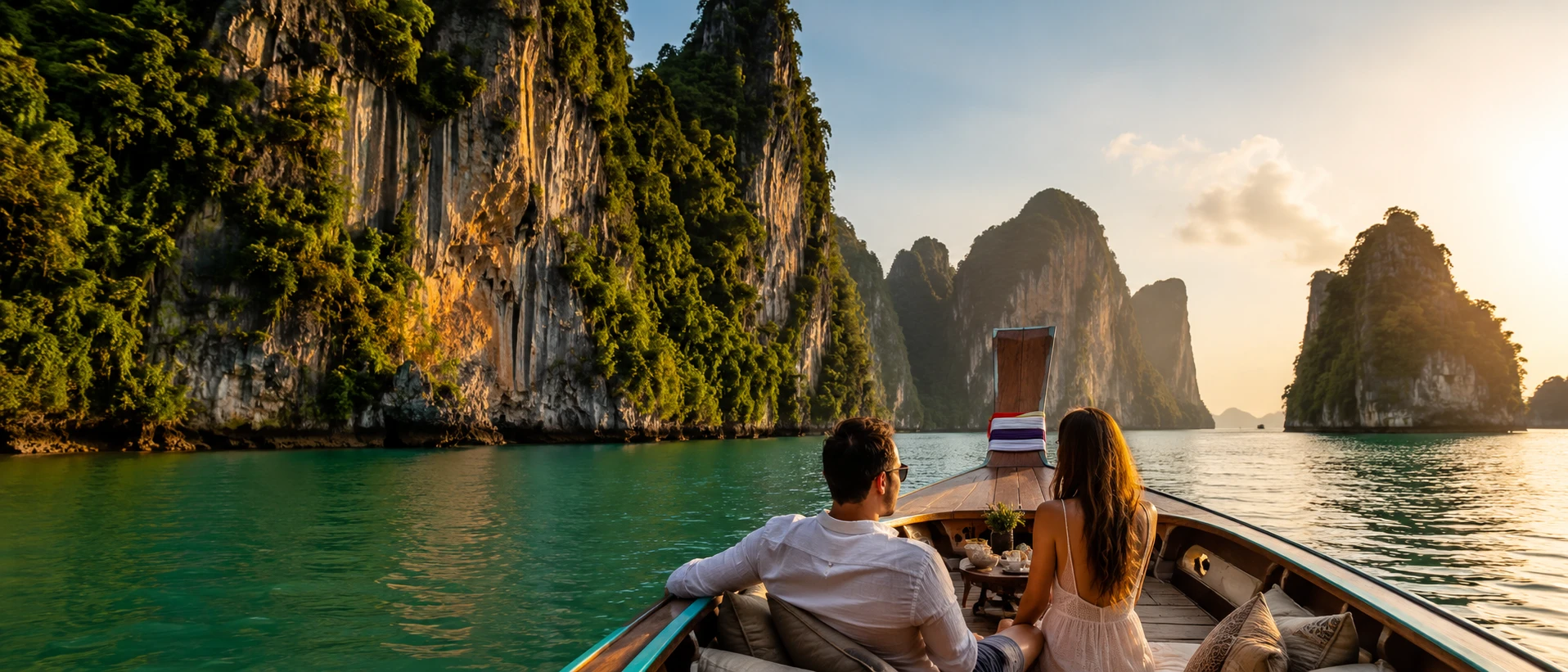
Asia Beyond the Standard Itinerary
China, Vietnam, Thailand, Cambodia and Laos — insider timing, hidden access and the small decisions that turn seeing Asia into experiencing it well.
Some of Asia's most memorable moments happen before breakfast.
At dawn in Hanoi, West Lake belongs to joggers and early-morning regulars rather than tour groups. In Beijing, parks fill with tai chi before the Forbidden City reaches full volume. At Angkor Wat, the first light catches ancient stone while half the crowd is still negotiating with hotel coffee.
Then there are the moments that require more than an early alarm.
Knowing which coast of Thailand works in which season. Understanding that Vietnam does not have one climate. Avoiding China's Golden Week unless you have an unusual enthusiasm for queues. Visiting the Mekong Delta while the floating markets are actually trading, rather than arriving hours later to photograph what remains.
That is the difference between seeing Asia and experiencing it well.
This guide looks at China, Vietnam, Thailand, Cambodia and Laos through that lens: what deserves your time, when to go, where timing matters, and how to move through each destination without simply following the standard itinerary.
China
Beijing, Xi'an, Zhangjiajie, Chengdu, Jiuzhaigou & Huanglong
China Rewards Travellers Who Understand Scale
China does very little modestly.
Its imperial palaces are enormous. Its ancient walls stretch farther than seems reasonable. Mountains rise through clouds like landscapes somebody invented after deciding ordinary mountains lacked drama.
And then, in the middle of all that scale, some of the most revealing moments are surprisingly small: residents exercising in a park, an old alleyway waking up, a courtyard door opening onto a neighbourhood that has existed in some form for generations.
China is often approached as a sequence of monuments.
It becomes much more interesting when you leave space between them.
Beijing: Before the City Fully Wakes
The Forbidden City and Summer Palace belong on a first itinerary for good reason, but Beijing becomes more human once you step away from monumental architecture.
Its historic hutong neighbourhoods — networks of narrow alleyways built around traditional courtyard homes — offer a glimpse of older urban life that survives alongside the capital's modern scale.
Go early.
The streets are quieter, residents are beginning their day, bicycles appear in doorways and the experience feels far removed from the organized intensity surrounding Beijing's major landmarks.
The same principle applies at the Temple of Heaven. The architecture is famous; the park around it is often just as memorable in the morning, when local residents exercise, practise tai chi and gather socially before the busiest visitor hours begin.
You came to see imperial China.
The park reminds you that Beijing is also somewhere millions of people simply live.
Xi'an: Much More Than an Army of Clay
The Terracotta Warriors deserve their reputation.
Thousands of life-sized figures created for the tomb complex of China's first emperor form one of the country's most extraordinary archaeological discoveries.
But Xi'an should not become a one-excursion city.
Huaqing Palace has long associations with China's imperial dynasties and hot springs, while the Ancient City Wall gives a physical sense of the city's historic scale.
Then there is the Muslim Quarter, where food, markets and religious traditions reveal another side of Xi'an's history as a major point on long-distance trade routes.
The Terracotta Warriors may be the photograph everyone recognizes.
Xi'an itself is the better story.
Zhangjiajie & Tianmen Mountain: Where the Landscape Stops Looking Real
Zhangjiajie's sandstone pillars rise in thin columns from forested valleys, often disappearing into mist.
The scenery became internationally associated with the floating mountains of Avatar, although the real landscape requires no cinematic assistance.
Zhangjiajie National Forest Park is dramatic in every season, but visibility matters. Fog can make the scenery wonderfully atmospheric or hide precisely the view you travelled across the world to see.
Nearby Tianmen Mountain offers a different kind of drama: steep cliffs, summit paths and, in clear weather, extraordinary views across the surrounding peaks.
Its cliffside glass walkways add a more modern thrill.
"Walkway" sounds reassuring.
"Transparent path attached to the side of a mountain" is perhaps more accurate.
Individual sections can occasionally close because of maintenance or weather conditions, so flexibility matters.
Chengdu: Pandas First, Engineering Later
At the Chengdu Research Base of Giant Panda Breeding, morning is the better time to visit.
Pandas are generally more active and likely to be feeding earlier in the day, before the afternoon encourages the sort of behaviour many travellers can relate to: lying down and refusing further commitments.
For those interested in another conservation experience, Bifengxia Panda Base lies near Ya'an in Sichuan Province, outside Chengdu.
Then change centuries entirely.
The Dujiangyan Irrigation System, more than 2,000 years old and still functional, is one of those places that quietly complicates the idea that ancient engineering was primitive.
It is not simply old.
It still works.
Few monuments make their point so efficiently.
Jiuzhaigou & Huanglong: Similar Map, Very Different Experience
These two UNESCO-listed landscapes are often combined, but they do not feel the same.
Jiuzhaigou — Expect clear lakes, forested valleys, mountain reflections and particularly striking autumn colour. The landscape changes considerably with the seasons, from green summer vegetation to vivid foliage later in the year.
Huanglong — Here, the visual drama comes from travertine terraces descending through the mountains in layered pools of mineral colour. It feels less like a conventional valley and more like geology deciding to become decorative.
Both destinations involve significant walking.
Huanglong also sits at high altitude, so pacing matters. Comfortable shoes, sensible expectations and awareness of altitude are more useful than heroic enthusiasm on the first uphill section.
When to Go
| Season | Best For | Why |
|---|---|---|
| Spring (Mar–May) | Wildflowers, mild temperatures, spring landscapes | Excellent for Beijing walks and many cultural itineraries; mountain conditions vary by elevation |
| Summer (Jun–Aug) | Green landscapes, waterfalls, high water levels | Jiuzhaigou and Zhangjiajie are lush, although summer is also a busy domestic travel period |
| Autumn (Sep–Nov) | Colours, generally comfortable temperatures | Jiuzhaigou's autumn foliage and often excellent conditions for Zhangjiajie |
| Winter (Dec–Feb) | Solitude, snow landscapes, lower seasonal demand | Snow, frost and frozen waterfalls are possible in mountain regions; fewer visitors in many areas |
Timing It Better
Mid-to-late October is generally the strongest period for Jiuzhaigou's autumn colours.
The catch is predictable: other people know this too.
Avoid China's National Day Golden Week around October 1–7 whenever possible. Domestic travel surges dramatically, and famous attractions can become extremely crowded.
For a completely different experience, mid-May can offer spring landscapes and lighter visitor numbers.
Vietnam
Hanoi, Ha Long Bay, Hoi An, the Mekong Delta & Da Lat
Vietnam Refuses to Have One Season
One of the most persistent mistakes travellers make with Vietnam is asking:
"What is the best month to go?"
The country is long enough, geographically varied enough and climatically complicated enough to make that question almost useless without another detail:
Where?
Hanoi can be cool while southern Vietnam is dry and warm. Central Vietnam may be experiencing rain while another part of the country has excellent conditions.
This is not an inconvenience.
It simply means the best Vietnam itineraries are designed around geography rather than a single weather chart.
Hanoi: The City Before the Motorbikes Take Over
Hanoi's Old Quarter becomes progressively more intense as the day builds.
Go early and the atmosphere changes.
Shutters rise. Breakfast appears. Small stools begin filling pavements. The traffic has not yet reached full theatrical commitment.
At Ho Tay — West Lake — sunrise brings joggers, exercise groups and residents beginning their day around the water.
The city's French colonial architecture is also particularly attractive in the softer morning light before traffic thickens.
The One Pillar Pagoda offers a very different piece of architectural history, while water puppetry remains one of Hanoi's most distinctive cultural traditions.
It is easy to dismiss water puppetry as something designed for visitors.
It has much deeper roots than that.
And watching wooden figures perform across a pool accompanied by traditional music is considerably more charming than the phrase "puppet show" initially suggests.
Ha Long Bay: Stay the Night
Ha Long Bay is famous enough that the limestone karsts no longer require introduction.
The mistake is treating them as a quick daytime photograph.
Spend a night on the water.
The experience changes early and late in the day, when the boat traffic shifts and the landscape becomes quieter. Wake at dawn, kayak through limestone scenery where conditions permit, explore caves and grottoes and swim in designated areas when available.
Ha Long Bay is at its best when you stop trying to see it quickly.
A landscape built over millions of years can probably have more than four hours of your itinerary.
Hoi An: Come for the Architecture, Stay for the Tailor's Tape Measure
Hoi An is one of Southeast Asia's most atmospheric historic trading towns.
Its architecture reflects centuries of commercial and cultural exchange, particularly between the 15th and 19th centuries, when the town developed as an important regional port.
By day, explore its old streets and historic buildings.
By night, lanterns transform the centre and the riverfront settles into a completely different mood.
Food deserves time here, particularly in family-run restaurants.
So does tailoring.
Hoi An has a long-standing made-to-measure clothing industry, and booking a private fitting with an established tailor can be one of the city's most enjoyable rituals.
There is something faintly addictive about choosing fabric in the afternoon and returning later to discover that somebody has apparently constructed clothing around your exact dimensions.
The suitcase home may require negotiation.
Mekong Delta: Set the Alarm
The Mekong Delta is often described through rice paddies, orchards, rivers and floating markets.
All true.
But the key word is early.
At Cai Rang Floating Market, trading begins around 5 AM, and the experience is liveliest when commerce is actually happening.
Arrive much later and you may still see boats.
You are simply arriving after much of the point.
This is a working river economy, not a performance timed around hotel breakfast.
Da Lat: Vietnam at a Different Temperature
Da Lat is a useful reminder that Vietnam is not entirely tropical heat and coastline.
Its elevation gives it a cooler climate, while French-influenced villas, gardens, coffee plantations and surrounding countryside create a very different atmosphere from the country's major coastal cities.
The Da Lat Flower Market, lake views and nearby agricultural landscapes make it a particularly appealing stop for travellers who want a break from Vietnam's more familiar route.
It remains surprisingly absent from many first itineraries.
That is partly why it works.
When to Go
Vietnam has no universal "best season."
Match the timing to the regions you are actually visiting.
| Season | Best For | Why |
|---|---|---|
| Nov–Dec | Northern Vietnam and southern Vietnam | Hanoi is cooler and the south is entering its drier period, while Central Vietnam can still experience significant rain |
| Jan–Feb | Culture, southern beaches, cooler northern travel | The north can be cool or misty; the south is generally dry. Tet can be fascinating culturally but requires advance planning because domestic travel is extremely busy |
| Mar–Apr | One of the strongest broader travel windows | Warmer conditions across much of the country, with Central Vietnam often becoming drier and sunnier |
| May–Sep | Green landscapes, regional beach travel, seasonal value | Hot and humid with seasonal rain in many regions, although weather varies considerably by location |
Timing It Better
For Hanoi and Ha Long Bay, September–November and April–May can provide an excellent balance of temperature and visibility.
Late November can also work very well for itineraries combining northern and southern Vietnam.
Central Vietnam, however, may still be wet.
Vietnam rewards travellers who plan by region rather than by country.
Thailand
Bangkok, Chiang Mai, Sukhothai, Ayutthaya, Phuket, Krabi & Koh Samui
Thailand's Biggest Planning Mistake Happens at the Beach
Thailand is unusually good at letting travellers assume everything will somehow work out.
Temples? Everywhere.
Excellent food? Very likely.
Island? Choose one.
Except the last part requires more thought than it appears.
Thailand's Andaman Coast and Gulf islands follow different rainfall patterns, meaning Phuket can be experiencing one season while Koh Samui is having another.
Choose the island first.
Then choose the month.
Not the other way around.
Bangkok: The City Makes More Sense Once You Stop Trying to Simplify It
Bangkok is palaces beside traffic, temples beside shopping malls and monks crossing streets beneath elevated rail lines.
The contrasts are half the attraction.
Start with the Grand Palace and Wat Phra Kaew, among the country's most important architectural and spiritual sites.
Then cross the perspective entirely with Wat Arun, particularly beautiful when viewed from across the Chao Phraya River.
Floating markets such as Amphawa and Damnoen Saduak are best approached early before their busiest tour periods.
And yes, take a tuk-tuk at least once.
It is not always the most practical method of transportation.
That is not why people remember it.
Chiang Mai: Temples, Markets and More Responsible Elephant Experiences
Inside Chiang Mai's Old City, temples such as Wat Chedi Luang and Wat Phra Singh reveal centuries of northern Thai religious and architectural history.
Morning temple rituals and chanting can be deeply atmospheric where visitors are welcome, but they should be approached respectfully rather than treated as performance.
Chiang Mai is also a major centre for elephant tourism.
Choose carefully.
Prioritize welfare-focused operators that avoid riding, performances and forced interaction.
A responsible experience should allow elephants to behave like elephants rather than employees with an unusually complicated job description.
At night, the city shifts toward markets, textiles, ceramics and street food.
Chiang Mai is slower than Bangkok.
It is not sleepy.
Sukhothai & Ayutthaya: Ruins Without Rushing
Both cities were once royal capitals.
Both contain extensive temple ruins.
They reward completely different energy from Bangkok.
Ayutthaya is easier to incorporate into many itineraries and can feel beautifully atmospheric in the early morning.
Sukhothai Historical Park is generally quieter and gives you more room to absorb the scale of the old capital.
Do not approach either as a list of temples to photograph in sequence.
Give the ruins time.
Ancient capitals rarely improve when experienced at the pace of airport security.
Phuket, Krabi & Koh Samui: Choose the Coast Before the Hotel
Thailand's beaches are often grouped together as though the country operates under one enormous umbrella forecast.
It does not.
On the Andaman side, Phuket and Krabi provide access to dramatic limestone scenery, beaches and offshore excursions.
Phang Nga Bay is famous for emerald water and limestone cliffs, with kayaking routes through lagoons and caves.
Railay Beach, reached by boat, sits beneath towering limestone cliffs and has one of southern Thailand's most recognizable coastal settings.
For something slower, Koh Lanta offers a more relaxed island rhythm with snorkelling and diving.
Koh Samui, on the Gulf side, follows a different rainfall pattern.
This matters enormously when planning.
A famous hotel in the wrong season is still a hotel in the rain.
When to Go
| Season | Best For | Why |
|---|---|---|
| Nov–Feb | Bangkok, northern Thailand and much of the Andaman Coast | Generally cooler and drier; excellent for temple visits and destinations such as Phuket and Krabi. Gulf islands such as Koh Samui can follow a different rainfall pattern, especially in November and December |
| Mar–Apr | Cultural travel and travellers comfortable with heat | Very hot across much of Thailand, often 35°C+; northern Thailand can also experience seasonal smoke and haze |
| May–Oct | Green landscapes, seasonal value, region-specific island travel | Rain increases across many areas, particularly the Andaman Coast, while Gulf islands can experience different seasonal patterns |
Timing It Better
February remains a very popular high-season month.
The weather may be comfortable across large parts of the country, but do not mistake good conditions for empty attractions.
For island trips, match the dates to the specific coast.
Thailand is one country.
Its beach weather does not always behave like one.
Cambodia
Siem Reap, Angkor, Phnom Penh & the Islands
Angkor Deserves More Than One Sunrise
There is a peculiar tendency among travellers to treat Angkor as a challenge.
See sunrise.
Visit Angkor Wat.
Race through Bayon.
Photograph Ta Prohm.
Return to hotel looking archaeological but exhausted.
This is an unfortunate way to experience one of the world's most extraordinary historic landscapes.
Give Angkor two to three days.
The temples deserve it.
So do you.
Angkor Archaeological Park: Slow Down
Angkor Wat remains the headline.
Sunrise is famous for good reason, but it is not the only moment that matters.
Bayon Temple, with its immense carved stone faces, feels completely different from Angkor Wat.
Then there is Ta Prohm, where tree roots have wrapped themselves around the ruins so thoroughly that nature and architecture appear to have reached a long-term arrangement.
Visit outside the busiest morning periods when possible.
And hire a knowledgeable local guide.
Without context, Angkor is extraordinary stonework.
With context, it becomes a story of rulers, religion, engineering, ambition and changing empires.
That is a considerable upgrade.
Siem Reap: Stay After the Temples
Siem Reap is not merely a hotel base for Angkor.
Its night markets, restaurants and artisan workshops make it worth spending time in town rather than collapsing immediately after temple touring.
Look for workshops working in silk weaving, stone carving and traditional crafts, particularly those supporting local makers.
A visit to Tonle Sap Lake can also add valuable context to the region.
Choose a responsible local operator and remember that the floating communities are homes and working communities, not sets arranged for visitor photography.
The distinction matters.
Phnom Penh: Cambodia's History Becomes More Complicated
The Cambodian capital feels very different from Siem Reap.
At the Royal Palace, traditional Khmer architecture and formal royal spaces sit near the riverfront.
The Silver Pagoda takes its name from the silver tiles covering its floor and holds important religious treasures.
Later in the day, the riverside becomes part public promenade, part social gathering space.
People exercise. Families gather. Food vendors appear.
Cities often reveal themselves more clearly once the official sightseeing is finished.
Phnom Penh is no exception.
Sihanoukville & the Islands: Use the Mainland as a Gateway
Sihanoukville functions as an important gateway to Cambodia's offshore islands.
For many leisure travellers, the real objective lies offshore.
Koh Rong and Koh Rong Sanloem offer beaches, snorkelling, diving and a slower island pace, with accommodation ranging from simple stays to more polished retreats.
Cambodia's coast does not have the same global beach reputation as Thailand.
That can be an advantage.
When to Go
| Season | Best For | Why |
|---|---|---|
| Nov–Feb | Peak — dry, cooler, clearer conditions | Angkor temples are more comfortable to explore and humidity is generally lower |
| Mar–May | Fewer visitors, travellers comfortable with heat | Very hot, especially in April; midday temperatures can exceed 35°C and the landscape is generally drier |
| Jun–Oct | Monsoon landscapes, lush scenery | Green countryside, higher rivers and fewer visitors, with regular seasonal rain |
Timing It Better
Late October into November deserves more attention.
The landscape can still be vividly green after the rains, visitor numbers are often lighter than during December and January, and temperatures begin moving toward more comfortable territory.
Dry season is easier.
The transition can be prettier.
Laos
Luang Prabang, Vang Vieng, Si Phan Don & Vientiane
Laos Is What Happens When the Itinerary Stops Shouting
Laos does not compete for attention in quite the same way as some of its neighbours.
There is less urgency.
Fewer mega-attractions.
More time spent beside rivers, walking through temple grounds or realizing that lunch has somehow occupied much of the afternoon.
This frustrates travellers who need constant stimulation.
Everyone else may begin wondering why they scheduled the next flight so soon.
Luang Prabang: Ritual, Temples and the Mekong
Luang Prabang is one of Southeast Asia's most atmospheric historic towns.
The morning alms-giving ceremony is among its most recognizable traditions, but it requires sensitivity.
Observe respectfully.
Avoid intrusive photography.
Participate only when properly guided in appropriate local etiquette.
The ceremony is a religious practice, not a dawn attraction staged for visitors.
At Wat Xieng Thong, elaborate temple architecture sits close to the Mekong.
Later, night markets bring lanterns, food and local crafts into the centre of town.
Then there is the river itself.
A sunset walk beside the Mekong may not sound like enough of an "activity" to earn its place on an ambitious itinerary.
That is precisely why it belongs there.
Vang Vieng: Beyond the Backpacker Reputation
For years, Vang Vieng was internationally associated with tubing and backpacker excess.
The landscape deserved better publicity.
Limestone karsts rise around the town, while the surrounding area offers caves, hiking routes, viewpoints and river activities.
Tubing remains available, but the destination now has far more to offer than its old party reputation suggests.
Climb to a viewpoint and the reason becomes obvious.
The scenery was there all along.
Si Phan Don: The 4,000 Islands
In southern Laos, the Mekong spreads into a landscape known as Si Phan Don — the 4,000 Islands.
Do not come expecting sophisticated resort infrastructure.
That is not the proposition.
The appeal lies in slow island life, fishing communities, river scenery and low-key accommodation.
Days become simple.
The river is present almost everywhere.
And the phrase "What should we do this afternoon?" gradually begins to feel unnecessarily demanding.
It will not suit everyone.
For the right traveller, that is the point.
Vientiane: A Capital That Refuses to Behave Like One
Vientiane is striking partly because it feels unusually relaxed for a national capital.
Pha That Luang is among Laos's most important national and religious symbols, while temples, cafés and the riverfront make the city easy to experience at a gentler pace.
Travellers arriving from Bangkok or Hanoi may find the contrast surprising.
There is less noise.
Less frenzy.
Less sense that you are somehow falling behind by sitting still for twenty minutes.
An underrated quality in a capital city.
When to Go
| Season | Best For | Why |
|---|---|---|
| Nov–Feb | Cooler, drier conditions | The most comfortable period for temples, walking and broader touring |
| Mar–Apr | Fewer visitors, travellers comfortable with heat | Very hot, with seasonal smoke and haze possible, particularly in northern areas; check air quality before travelling |
| May–Oct | Green landscapes, rivers and waterfalls | Wet-season rain, higher rivers and lush scenery, with lower visitor numbers in many areas |
Timing It Better
November–February remains the easiest period for most travellers.
The weather is generally more comfortable for walking, touring and temple visits.
May–October trades predictability for greener landscapes, fuller rivers and fewer visitors.
March–April can be extremely hot, and seasonal burning can affect northern air quality.
In Laos, travelling slowly is not merely stylistic advice.
In hot season, it is also sensible.
So When Is the Best Time to Visit Asia?
There isn't one.
Asia is too large, the climates are too varied and even individual countries can contain several completely different weather patterns.
The better question is:
Where exactly are you going, and what matters most once you get there?
As a broad guide:
- November–February: Often an excellent period for Cambodia, Laos, mainland Thailand and parts of Vietnam, with cooler and drier weather in many regions.
- March–April and September–October: Excellent in some places, but heat, monsoon transitions and seasonal haze can complicate others.
- May–August: Wetter or more humid across many mainland destinations, frequently with lower demand and greener scenery, but conditions vary considerably by region and coast.
The calendar is a starting point.
The itinerary decides whether it works.
Four Questions to Ask Before Choosing Your Dates
How Much Heat Can You Actually Tolerate?
There is a considerable difference between enjoying warm weather beside a pool and walking through temple complexes at 35°C+.
Heat affects pace.
Humidity affects energy.
An itinerary that looks perfectly reasonable from an air-conditioned room in Canada may feel rather ambitious under the April sun in Cambodia.
How Much Do Crowds Matter to You?
Peak season is popular because conditions are often good.
It is also popular because everyone else has noticed the same thing.
Look beyond international holiday periods and check major local holidays, school breaks and domestic travel peaks.
China's Golden Week is the obvious example.
Arriving at a famous site during the wrong holiday can transform "iconic cultural experience" into "advanced crowd navigation."
How Important Are Photographs?
Dry-season skies can produce clearer views in many destinations.
But mist, haze, monsoon weather and regional smoke can change visibility dramatically.
Zhangjiajie in mist can be extraordinary.
Zhangjiajie in enough mist to hide Zhangjiajie is a slightly different proposition.
Build flexibility into photography-focused trips.
Are You Chasing Price or Experience?
Wet-season and shoulder-season travel often brings lower prices and smaller crowds.
Sometimes this is an excellent trade.
Sometimes the activity you came for is heavily affected by weather.
Lower room rates mean little if poor sea conditions cancel the boat excursion that persuaded you to book the island.
Value is not always the cheapest price.
The Small Decisions That Make Asia Better
Visit Famous Places Earlier Than Feels Civilized
Where opening hours allow, 6–8 AM can be transformative.
Major sites are cooler, quieter and easier to appreciate before tour groups arrive.
The difficulty is getting out of bed.
History has survived several centuries.
It will still be there after coffee.
Hire Local Guides for Places Where Context Matters
Some places are visually impressive without explanation.
They become far more compelling with it.
Angkor, Beijing, Xi'an and ancient capitals such as Ayutthaya and Sukhothai all benefit from someone who can explain not simply what you are looking at, but why it matters.
The best guides also know timing, quieter routes and which sections deserve more attention.
That information can be more valuable than another attraction squeezed into the day.
Eat Beyond the Obvious Streets
Night markets deserve their reputation, but so do neighbourhood restaurants, small family-run places and local cafés outside the busiest tourism districts.
Food is one of the easiest ways to understand how a destination actually lives.
You do not need to search for the place with the longest queue of foreigners.
Sometimes the interesting meal is two streets away.
Stay Longer in Fewer Places
Three nights is often more useful than one.
Two destinations experienced well usually produce a stronger trip than five experienced through car windows and airport lounges.
Asia rewards slow travel because the best moments are not always scheduled.
A market you did not expect.
A conversation after lunch.
A temple courtyard when nobody else happens to be there.
You cannot plan every good travel memory.
You can, however, leave enough time for one to occur.
Ask Better Questions
Instead of asking only:
"What should tourists see?"
Try:
"Where do you go?"
Local recommendations often lead to parks, markets, neighbourhood restaurants and viewpoints that never become international landmarks.
They may not be the reason you flew to Asia.
They can easily become the thing you remember.
The Talaria View
Asia's great monuments are not difficult to find.
Angkor Wat will still be in the guidebook.
The Terracotta Warriors are unlikely to disappear from China itineraries.
Ha Long Bay will continue appearing in photographs, and Thailand will presumably remain in possession of several very attractive beaches.
The more interesting question is how you experience them.
At what hour.
In which season.
With whom.
And what you allow yourself to notice once the headline attraction is finished.
Sometimes the difference is arriving before the crowds.
Sometimes it is staying overnight rather than making a day trip.
Sometimes it is understanding that the famous beach is on the wrong coast for your travel dates.
And sometimes it is simply leaving one afternoon empty.
Because the best itineraries do not try to see everything.
They create enough space to actually experience something.
Travel requirements, hotel offerings, airline schedules and entry conditions can change. Destination information should always be reconfirmed for your specific travel dates before departure.
Want to explore Asia beyond the guidebook? Let's design a journey around what actually matters to you.
Or reach us directly on WhatsApp — we respond fast and love talking Asia.
Talaria Voyages is a Canadian-based luxury travel atelier, IATA TIDS registered (Code: 96235812), serving travellers worldwide.